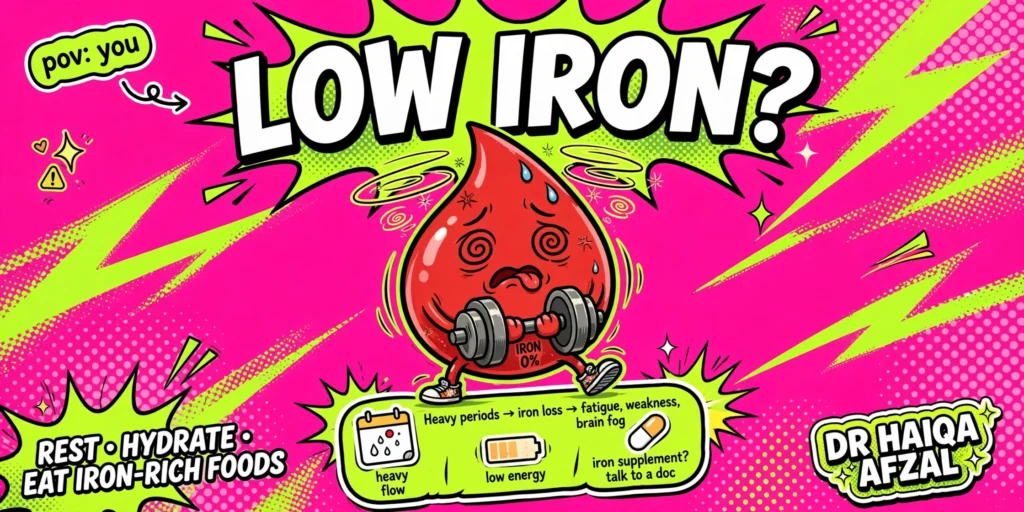
The short answer
Why do heavy periods cause iron deficiency? Every millilitre of blood carries iron with it, and when menstrual loss outpaces what the body can replace from food, iron stores fall. If your periods regularly soak through protection, last longer than a week, or include large clots, you are losing blood faster than most diets can replenish. Over months, this can progress from low iron stores to iron deficiency anaemia, which causes fatigue, breathlessness and difficulty concentrating.
Iron deficiency in women with heavy periods is common and often goes unrecognised. Research from Sweden found that more than half of teenage girls experienced heavy menstrual bleeding and four in ten were iron deficient. New cost-effectiveness research published in Blood Advances suggests that treating the iron loss more decisively, with an earlier single dose of intravenous iron, may deliver better value and better quality of life than months of iron tablets. But treating the bleeding itself matters just as much as replacing the iron. This article explains how to recognise the problem, how doctors test for it, and what good care looks like.
What counts as heavy menstrual bleeding?
Heavy menstrual bleeding is defined by NICE as blood loss that interferes with physical, social or emotional quality of life. That is a deliberately practical definition. It means the question is not really “how many millilitres” but “is your bleeding disrupting your life?”
For clinical purposes, bleeding is generally considered heavy if any of the following apply:
- You need to change a pad or tampon every hour or two for several hours in a row.
- Your periods last longer than seven days.
- You pass clots larger than a 10 pence coin.
- You bleed between periods or after sex.
- You need to use double protection, change protection overnight, or avoid activities because of bleeding.
Many women compare only with their own previous experience and do not realise their bleeding counts as heavy. In the Swedish study of 394 teenage girls, the researchers noted that many participants had no idea what counted as heavy menstrual bleeding, and that simple questionnaires could identify those at risk. If your periods consistently limit what you can do, it is worth raising with your GP, whatever you have previously considered normal.
Why do heavy periods cause iron deficiency?
Iron is an essential building block of haemoglobin, the protein in red blood cells that carries oxygen around the body. The body recycles most of its iron, but every episode of blood loss carries some iron out of the body, and menstruation is one of the most consistent sources of iron loss in women of reproductive age.
A typical diet provides a modest amount of absorbable iron each day. When menstrual blood loss is heavy month after month, the iron leaving the body exceeds the iron coming in. The body first draws on its stored iron, measured by a blood test called ferritin. When stores are depleted, the body begins to produce red blood cells with less haemoglobin, and iron deficiency anaemia develops. This progression from low stores to anaemia can take months, which is one reason the condition creeps up on people. Fatigue is attributed to stress, poor sleep or simply being busy, and the connection with menstrual bleeding is not made.
Diet influences how quickly stores fall. Iron from meat (haem iron) is absorbed more efficiently than iron from plant foods, so people who eat little or no meat are more vulnerable when bleeding is heavy. Tea and coffee with meals can reduce iron absorption, while vitamin C with meals can improve it. But diet alone rarely compensates for truly heavy bleeding, which is why medical assessment matters. Nutritional gaps can overlap too: many people in the UK run low on vitamin D through autumn and winter, as explained in our guide to vitamin D supplements.
How common is iron deficiency in women with heavy periods?
Heavy menstrual bleeding is one of the commonest causes of iron deficiency in women of reproductive age, and the numbers are striking. The American Society of Hematology notes that nearly a third of women worldwide experience iron deficiency anaemia. Women with heavy menstrual bleeding, defined as more than 80 millilitres of loss a month or any level of bleeding that significantly affects quality of life, are at especially high risk.
The Swedish research published in PLOS One gives a clear picture in adolescents. Among 394 post-menarchal girls aged 15 and older at two upper secondary schools, 53 percent reported heavy menstrual bleeding and 40 percent were iron deficient, defined as ferritin below 15 micrograms per litre. Girls with heavy bleeding had three times the odds of iron deficiency compared with girls with normal bleeding. When heavy bleeding was combined with a meat-restricted diet, the odds rose to 13.5 times. The study’s authors highlighted that a simple questionnaire could help schools and clinics identify girls most at risk, offering a fast and inexpensive way to prevent anaemia in young women.
These figures matter because iron deficiency in adolescence coincides with years of intense growth, learning and examination pressure. Tiredness and difficulty concentrating are often attributed to lifestyle or attitude, when a blood test might reveal a treatable cause.
What are the symptoms of iron deficiency and iron deficiency anaemia?
Iron deficiency without anaemia can cause symptoms on its own, and symptoms usually worsen once anaemia develops. The commonest include:
- Persistent tiredness and lack of energy that does not lift with rest.
- Shortness of breath, especially on exertion such as climbing stairs.
- Noticeable heartbeats, known as palpitations.
- Pale skin, and sometimes pale inner eyelids.
- Headaches, dizziness or feeling lightheaded.
- Difficulty concentrating and a sense of mental fogginess.
- Brittle nails, hair shedding, or a sore, smooth tongue.
- Unusual cravings for non-food items such as ice, clay or starch, a condition called pica.
- Restless legs, particularly in the evening.
Severe iron deficiency anaemia can also worsen existing conditions such as angina or heart failure. Anyone with chest pain, fainting, or very severe breathlessness should seek urgent medical care rather than waiting for a routine appointment.
It is worth emphasising that these symptoms overlap with many other conditions, including thyroid disorders, depression and sleep problems. Women in midlife may also find it hard to tell whether mood and concentration changes are hormonal; our guide to perimenopause, anxiety and low mood explains what good care looks like. Symptoms alone do not make the diagnosis; they make the case for a blood test.
How is iron deficiency diagnosed?
The diagnosis starts with a conversation and a blood test. NICE guidance recommends a full blood count for all women with heavy menstrual bleeding presenting in primary care. Your GP will also want a detailed menstrual history: how often you bleed, how long bleeding lasts, how often you change protection, whether you pass clots, and whether bleeding interferes with daily life.
The blood tests typically include:
- Full blood count (FBC): shows haemoglobin levels and whether red blood cells are small and pale, which is typical of iron deficiency.
- Serum ferritin: the key measure of iron stores. Under NHS haematology guidance, a ferritin below 30 micrograms per litre confirms low iron stores, and a ferritin below 15 confirms iron deficiency.
- C-reactive protein (CRP): ferritin rises in the presence of inflammation, so a normal or high ferritin during infection or inflammation can mask a true deficiency. CRP helps interpret the result.
Where the diagnosis is unclear, doctors may also check transferrin and transferrin saturation, or screen for coeliac disease, since coeliac disease is found in a small percentage of people with iron deficiency anaemia. If you are already anaemic, your GP will also consider whether any gastrointestinal symptoms warrant separate investigation, though in a young woman with obviously heavy periods, the bleeding is the likely explanation.
What does the new research say about IV iron?
The standard first-line treatment for iron deficiency is oral iron tablets, usually taken for several months, followed by repeat blood tests. Tablets are inexpensive and widely available. But they have well-known limitations: they commonly cause nausea, constipation or stomach upset, they are absorbed poorly by some people, and adherence is often poor. Iron absorption is also partly self-limiting: after each dose, the hormone hepcidin rises and reduces absorption of the next dose, which is one reason alternate-day dosing is sometimes used.
New research published in Blood Advances in January 2026 has challenged the assumption that tablets should always come first for women whose iron deficiency is driven by heavy menstrual bleeding. Researchers at Yale School of Medicine, led by medical student Daniel Wang with senior author Dr George Goshua, built a model simulating the reproductive lifetime of women aged 18 to 51 with heavy menstrual bleeding and iron deficiency anaemia. They compared four strategies: first-line intravenous iron dextran (a single 1,000 mg dose given over two hours), two other IV iron formulations, and alternate-day oral ferrous sulfate.
The model found that a single dose of IV iron dextran was the most cost-effective approach. It yielded 19.26 quality-adjusted life years at a lifetime cost of about $157,500, compared with 19.10 quality-adjusted life years at about $152,900 for oral iron, giving an incremental cost-effectiveness ratio of $28,600 per quality-adjusted life year. Patients receiving IV iron maintained healthy iron levels for at least 30 months, while with oral supplements the anaemia returned within 36 months despite the continued effort of taking tablets. The researchers concluded that IV iron delivered the highest value for cost and substantially improved quality of life.
A few cautions are needed before this changes anything for individual patients. This was a cost-effectiveness model with US costs, not a randomised trial, and it does not by itself rewrite clinical guidelines. In the UK, oral iron remains the usual first-line treatment, and IV iron is generally reserved for people who cannot tolerate or absorb oral iron, who need rapid repletion, or who continue to lose iron faster than tablets can replace. IV iron is given in a clinical setting with monitoring, because a small risk of allergic reaction means it should not be given casually. But the study is a serious piece of evidence that for women with ongoing heavy bleeding, moving to IV iron earlier rather than later may be both better medicine and better value. If you have been on iron tablets for months without your levels recovering, it is a conversation worth having with your doctor.
Treating the cause matters as much as replacing the iron
Iron replacement corrects the deficiency, but it does not correct the reason for it. Heavy menstrual bleeding itself deserves investigation, because treatable causes are common. These include uterine fibroids, endometrial polyps, adenomyosis, ovulatory disorders, thyroid problems and, less commonly, inherited bleeding disorders such as von Willebrand disease. Being alert to bodily changes matters in other areas of women’s health too; see our honest clinical guide to breast screening and self-awareness.
Your GP may arrange a pelvic ultrasound, thyroid function tests, or referral to gynaecology depending on your age, symptoms and examination findings. Treatments for heavy menstrual bleeding itself range from tranexamic acid and the hormonal coil to endometrial ablation or, where appropriate, surgery for fibroids. Reducing the bleeding is often the most durable way to keep iron levels up, and it addresses the quality-of-life impact that iron tablets alone cannot fix.
This is also the point at which to be honest about normalisation. Many women endure heavy periods for years because they were told it runs in the family, or because they assume nothing can be done. If bleeding regularly disrupts your work, your sleep or your plans, that is a medical issue worth investigating, not something to accept.
When should you see your GP?
Book a routine appointment if your periods are heavy by the measures above, or if you have persistent tiredness, breathlessness, palpitations, restless legs, unusual food cravings, hair shedding or difficulty concentrating that does not improve with rest. Mention your menstrual history explicitly, including how often you change protection and whether you pass clots, since this is the detail that connects the symptoms to the likely cause.
Seek more urgent care if you are soaking through a pad or tampon every hour for several hours, feel faint or dizzy, have chest pain or severe shortness of breath, or experience any bleeding after the menopause or between periods that is new for you. Postmenopausal bleeding should always be assessed promptly.
Frequently asked questions
Why do heavy periods cause iron deficiency in women?
This is why heavy periods cause iron deficiency: menstrual blood contains iron, and heavy monthly losses can exceed the iron the body absorbs from food. When iron leaving the body outpaces iron coming in, stored iron (ferritin) falls, and over months this can progress to iron deficiency anaemia. That is why iron deficiency is so common in women with heavy menstrual bleeding.
What are the signs of iron deficiency from heavy periods?
The commonest signs are persistent tiredness, shortness of breath on exertion, palpitations, pale skin, headaches, difficulty concentrating, brittle nails and hair shedding. Unusual cravings for ice or non-food items (pica) and restless legs can also occur. Symptoms overlap with other conditions, so a blood test is needed to confirm the diagnosis.
How do doctors test for iron deficiency?
The usual tests are a full blood count and a serum ferritin level. Under NHS guidance, a ferritin below 30 micrograms per litre confirms low iron stores, and below 15 confirms iron deficiency. Doctors also check CRP, because ferritin rises with inflammation and can otherwise mask a true deficiency. NICE recommends a full blood count for all women with heavy menstrual bleeding seen in primary care.
Is IV iron better than tablets for iron deficiency from heavy periods?
It depends on the situation. Oral iron remains the usual first-line treatment in the UK. But a 2026 cost-effectiveness study in Blood Advances found that a single dose of IV iron dextran was more cost-effective than months of oral iron for women with heavy menstrual bleeding and iron deficiency anaemia, with better quality of life and longer-lasting results. IV iron is typically used when tablets are not tolerated or not working, and it is given in a clinical setting with monitoring.
Should I just take iron tablets if my periods are heavy?
Not without assessment. Iron tablets treat the deficiency but not the cause. Heavy menstrual bleeding itself should be investigated, because treatable causes such as fibroids, polyps or thyroid problems are common, and treatments that reduce bleeding often keep iron levels up more durably. See your GP for a menstrual history and blood tests first.
When should I see a GP about heavy periods and tiredness?
Book an appointment if bleeding regularly soaks through protection, lasts longer than seven days, includes large clots, or disrupts your life, or if you have persistent fatigue, breathlessness or palpitations. Seek urgent care for very heavy bleeding with faintness or chest pain, and always have postmenopausal bleeding assessed promptly.
References and further reading
- Wang D et al. Cost-effectiveness of first-line intravenous iron vs oral iron for women with heavy menstrual bleeding and iron deficiency anemia. Blood Advances. 2026. Summary: American Society of Hematology press release, 8 January 2026. https://www.hematology.org/newsroom/press-releases/2026/iv-iron-is-the-cost-effective-treatment
- Soderman L, Wolff M et al. Exploring the effect of menstrual loss and dietary habits on iron deficiency in teenagers: a cross-sectional study. PLOS One. 2025. DOI: 10.1371/journal.pone.0336688. https://journals.plos.org/plosone/article?id=10.1371/journal.pone.0336688
- NICE. Heavy menstrual bleeding: assessment and management. NICE guideline NG88. https://www.nice.org.uk/guidance/ng88
- NHS. Iron deficiency anaemia. https://www.nhs.uk/conditions/iron-deficiency-anaemia/
This article is for general information and does not replace personal medical advice. If you are concerned about heavy menstrual bleeding or symptoms of iron deficiency, please speak to your GP or another qualified clinician.