The short answer
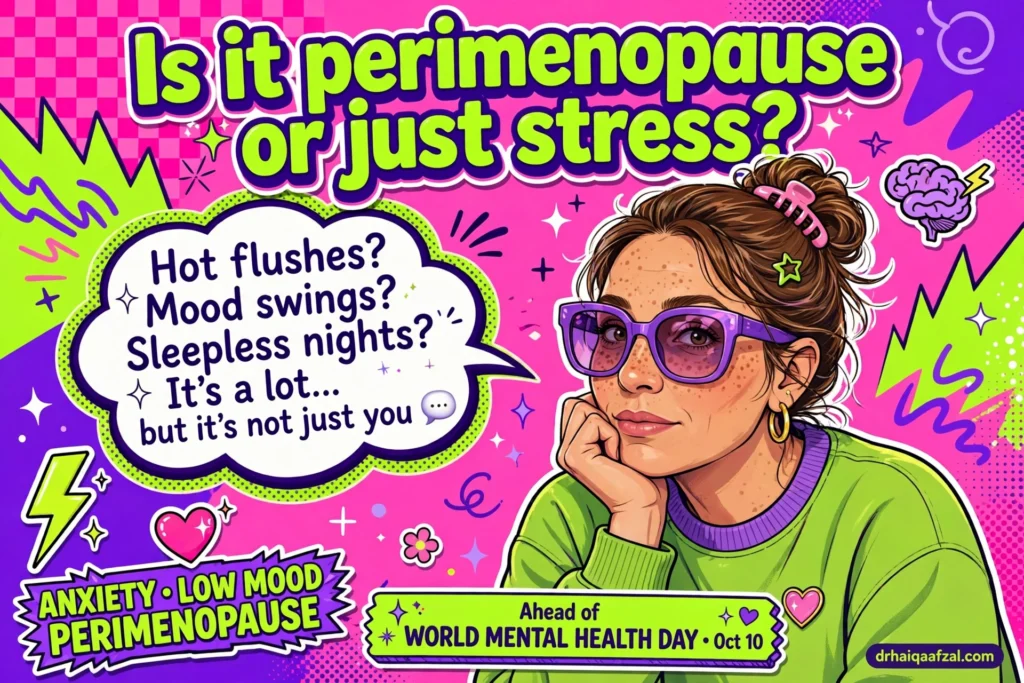
Can perimenopause cause anxiety and low mood? Yes. In the years before menopause, fluctuating hormone levels can affect mood, sleep, concentration and emotional resilience. Research suggests women entering perimenopause face around double the risk of developing significant depressive symptoms compared with women who remain premenopausal, and surveys repeatedly find that many women do not realise their psychological symptoms are linked to this life stage.
World Mental Health Day falls on 10 October each year. This year’s World Health Organization theme, “Lived experiences heard: real voices, real change”, calls for people with lived experience of mental health conditions to help shape the care they receive. It is a fitting moment to talk about a group whose experiences have routinely gone unheard: women navigating perimenopause.
If you are in your forties and have noticed anxiety, low mood, irritability, disturbed sleep or a sense that you no longer feel like yourself, you are far from alone, and the cause may be one that has not yet been named.
What perimenopause is, and when it starts
Perimenopause is the transition in the years leading up to menopause, when the ovaries gradually wind down and levels of oestrogen and progesterone begin to fluctuate before eventually declining. It most commonly begins in a woman’s forties, although it can start earlier, and it can last several years. Menopause itself is confirmed when periods have stopped for 12 consecutive months.
In the United Kingdom, guidance from the National Institute for Health and Care Excellence (NICE) advises that perimenopause can be diagnosed in women over 45 on the basis of symptoms such as hot flushes, night sweats and irregular periods, without the need for blood tests.
Why hormones affect mood
Oestrogen does far more than regulate the menstrual cycle. It influences the brain systems involved in mood, sleep, attention and stress tolerance, including the neurotransmitters serotonin, dopamine and noradrenaline. When oestrogen becomes erratic in perimenopause, these systems can be unsettled too, which helps explain why mood, sleep and concentration often deteriorate together.
This is not simply a matter of feeling emotional about getting older. The menopause transition is recognised in clinical research as a window of vulnerability for mental health, when the risk of new mood symptoms rises even in women with no previous history of depression.
How common are perimenopausal mood symptoms?
The numbers are striking, and they are consistent across several recent surveys:
- In a 2026 LifeStance Health survey of 1,000 women experiencing perimenopause or menopause, 66 percent rated their anxiety as somewhat or extremely severe and 54 percent said the same of their depression, yet one in three respondents did not know that perimenopause could cause mental health symptoms at all.
- A recent menopause survey reported that anxiety, irritability or mood changes affected 59.2 percent of respondents, alongside fatigue or low energy (69.8 percent), sleep problems (67.8 percent) and brain fog or difficulty concentrating (64.3 percent). Among respondents who were perimenopausal or unsure of their status, 76.4 percent said they had not immediately recognised that their symptoms could be connected to hormonal changes.
- A global survey of more than 12,000 adults aged 35 and over, reported by Healio, found self-reported rates of 75 percent for anxiety, 77 percent for depressive mood and 80 percent for irritability, with the authors noting that fatigue from perimenopause may be influenced by oestrogen fluctuations disrupting sleep regulation, and that mood changes are largely attributed to hormonal fluctuations affecting neurotransmitter and stress-response regulation.
- The same recent menopause survey found that 30.5 percent of respondents had been told by a healthcare provider that they were too young to be experiencing hormone-related symptoms, and 55 percent said a provider had never discussed the possible long-term considerations of hormone therapy relating to bone, heart, brain and sexual health.
Perhaps most tellingly, a long-running US study known as the Harvard Study of Moods and Cycles found that women entering perimenopause were around twice as likely to develop significant depressive symptoms as women who remained premenopausal.
Is it perimenopause, or is it depression?
This is the question women ask most often, and it deserves an honest answer: the two can look alike, they can coexist, and telling them apart properly requires a clinician. That said, there are patterns that point more strongly toward a perimenopausal origin:
- Symptoms began in your forties, around the time your periods became irregular or your cycle changed.
- Mood symptoms arrived alongside physical signs such as hot flushes, night sweats, disturbed sleep or vaginal dryness.
- You notice a cyclical pattern, with low mood or anxiety intensifying at particular points in your cycle.
- The change feels new and out of character, rather than a return of a familiar pattern of depression.
It is also possible to have both perimenopause and a depressive disorder, and each deserves treatment in its own right. If depression is diagnosed, it should be managed according to established clinical guidance for depression. The key point is that a new cluster of mood symptoms in midlife should prompt a conversation about hormones, not an assumption that the two are unrelated.
What the clinical guidance recommends
NICE guideline NG23 on menopause, updated in 2024, sets out how psychological symptoms linked to the menopause transition should be approached:
- Consider HRT to alleviate low mood that arises as a result of the menopause, after discussing the benefits and risks.
- Consider cognitive behavioural therapy (CBT) to alleviate low mood or anxiety that arises as a result of the menopause. NICE found that psychological therapies such as CBT could alleviate these symptoms, and CBT is also recommended for menopause-related sleep difficulties.
- Antidepressants are not the automatic answer. Current NICE clinical knowledge summaries advise that SSRIs and SNRIs should not be used first-line for low mood in menopausal women who have not been diagnosed with depression, since there is no clear evidence they ease low mood in this group.
- Adapt treatment as symptoms change, because perimenopause is a moving target and a plan that works at one stage may need revision at the next.
Worryingly, in the recent menopause survey mentioned above, antidepressant or anti-anxiety medication was the most frequently recommended treatment category (reported by 34.2 percent of respondents), more than any individual hormone therapy option. That pattern sits uneasily alongside guidance that reserves antidepressants for diagnosed depression rather than menopause-related low mood.
Talking to your GP: a practical approach
Good care starts with a clear conversation. If you suspect perimenopause is affecting your mental health, consider these steps:
- Keep a symptom diary for two to three cycles. Note mood, anxiety, sleep, hot flushes and where you are in your cycle. Patterns are powerful diagnostic evidence.
- Describe the impact, not just the symptoms. Explain how low mood or anxiety is affecting your work, your relationships and your daily life. Clinicians respond to functional impact.
- Ask directly about options. You can ask whether HRT might be appropriate for your low mood, whether CBT is available locally or through NHS Talking Therapies, and whether a referral to a menopause specialist clinic would help.
- Bring a list of your medicines and any family history of breast cancer, blood clots or osteoporosis, since these inform decisions about hormone therapy.
- Seek a second opinion if you feel dismissed. If you are told you are too young, or that your symptoms are just stress, you are entitled to see another clinician.
When to seek help urgently
Low mood can deepen into something more serious. If you have thoughts of harming yourself, or you feel you may act on them, seek help immediately. In the UK, you can call Samaritans free on 116 123 at any time, day or night, or contact your GP, call 111, or go to your nearest A&E. You do not need to be certain it is an emergency to reach out.
Frequently asked questions
Can perimenopause cause anxiety even if I have never been anxious before?
Yes. Clinical research identifies perimenopause as a window of vulnerability for new mood symptoms, and studies show the risk of significant depressive symptoms roughly doubles during the transition. New-onset anxiety in your forties, especially alongside cycle changes or sleep disruption, is worth discussing with your GP as a possible hormonal cause.
How long do perimenopausal mood symptoms last?
It varies. Perimenopause itself typically lasts several years, and psychological symptoms can persist through the transition and into early postmenopause. Because symptoms fluctuate, keeping a diary helps you and your clinician see the true pattern over time.
Will HRT help my mood, or is it only for hot flushes?
NICE guidance advises considering HRT to alleviate low mood that arises as a result of the menopause, not only vasomotor symptoms such as hot flushes and night sweats. Whether it is right for you depends on your individual risks and benefits, which your GP or a menopause specialist can discuss with you.
Is CBT really effective for menopause-related anxiety?
NICE found that CBT can alleviate low mood and anxiety arising as a result of the menopause, and it is also recommended for menopause-related sleep difficulties. CBT for menopause focuses on practical strategies for managing symptoms, unhelpful thought patterns and the impact of disrupted sleep.
Should I just wait for it to pass?
Waiting is understandable, but it is not the only option, and for many women symptoms are disruptive enough to affect work, relationships and quality of life. Guidance exists precisely because effective treatments are available. If symptoms are interfering with your life, that alone is reason enough to seek help.
References and further reading
- World Health Organization. World Mental Health Day 2026: Lived experiences heard, real voices, real change.
- NICE guideline NG23: Menopause, identification and management (updated 2024); NICE Clinical Knowledge Summary on menopause management.
- LifeStance Health. Perimenopause and Mental Health: Depression, Anxiety and ADHD.
- Healio. Study reveals a global lack of knowledge about perimenopausal symptoms.
- EIN Presswire. Report on women’s menopause experiences following FDA hormone therapy labelling changes.
This article is for general information and does not replace personal medical advice. If you are concerned about your mental health or think you may be perimenopausal, please speak to your GP or another qualified clinician.