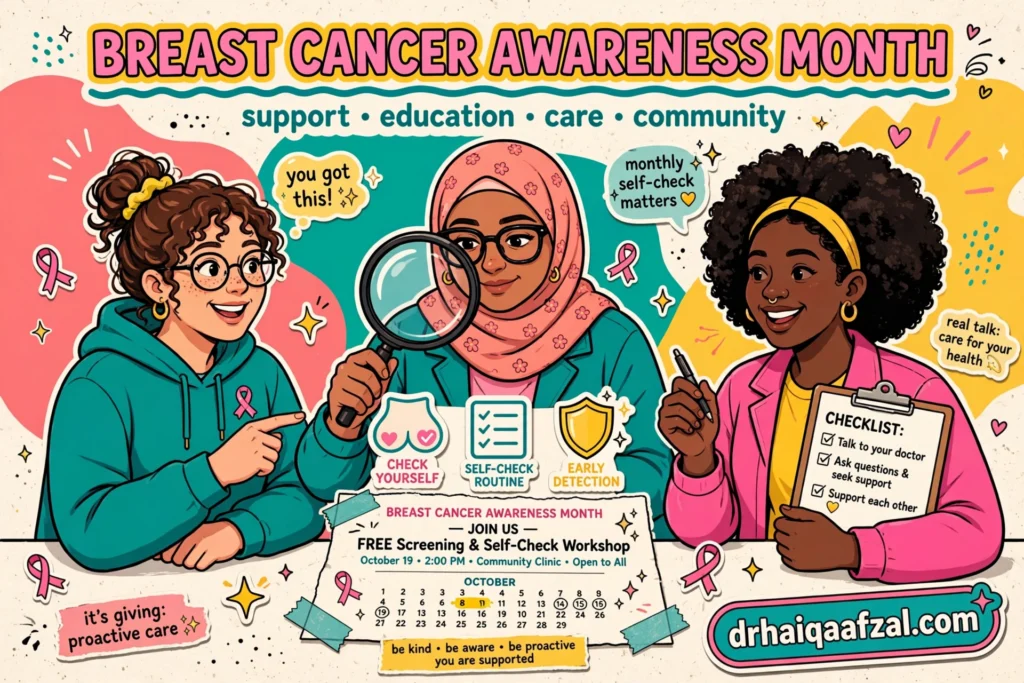
October is Breast Cancer Awareness Month. The World Health Organization theme for 2026 is “Every story is unique, every journey matters”, a reminder that behind every screening invitation and every diagnosis is a person with her own history, worries and support network. This guide explains, in plain clinical terms, what breast screening involves in the UK, how to be breast aware between appointments, and which changes should prompt a GP visit without delay.
This article is general information. It does not replace individual medical advice. If you notice a new or unusual change in your breast, chest or armpit, contact your GP practice promptly, even if you have had a normal screening result recently.
What is breast screening and who is invited in the UK?
Breast screening uses low dose X-rays called mammograms to look for cancers that are too small to see or feel. The NHS Breast Screening Programme in England invites anyone registered with a GP as female aged from 50 up to their 71st birthday. A first invitation arrives between the ages of 50 and 53, and invitations then repeat every three years until the age of 71. You need to be registered with a GP practice to be invited automatically.
Breast cancer is the most common cancer in women in the UK, where about 1 in 7 women will be diagnosed during their lifetime. Globally, the WHO reported that 2.4 million women were diagnosed in 2024 and 694,000 died from the disease, with 8.2 million women living with breast cancer at the end of that year. Around 80 percent of breast cancers occur in women with no specific risk factors other than sex and increasing age, which is why population screening is offered by age rather than by symptoms alone.
Screening is for people without symptoms. If you have a lump, skin change, nipple change or any other new symptom, do not wait for your next screening invitation. Book a GP appointment and explain the change clearly.
If you are aged 71 or over, you will not be invited automatically, but you can still arrange screening every three years by contacting your local breast screening service. If you have missed an invitation, have moved GP practice, or believe you should have been invited by age 53 and have not, contact your GP practice or your local screening unit to check your details.
What happens at a breast screening appointment?
A mammogram is performed by a specialist called a mammographer, who will be female. The appointment itself usually takes around 30 minutes, although the X-ray part takes only a few minutes.
You will be asked to undress from the waist up in a private changing area, so wearing a separate top and bottom rather than a dress is practical. You may be offered a gown. The mammographer will check your details, ask about any previous breast problems or mammograms, and explain each step.
Each breast is placed in turn on the X-ray machine and compressed firmly between two plates to keep it still and to obtain a clear image. In a standard screening appointment, two images are taken of each breast. The compression lasts only a few seconds for each image, and the machine is then released straight away. You can ask the mammographer to stop at any point if you need a pause.
It can help to avoid deodorant, talcum powder or creams on the breasts and under the arms on the day, as these can sometimes show up on the image. If you have breast implants, a pacemaker, limited shoulder movement, or you use a wheelchair, tell the screening unit in advance so that extra time and the right positioning support can be arranged.
Does breast screening hurt and how long does it take?
Most women describe compression as uncomfortable, and some find it briefly painful, but it lasts only a few seconds per image. Tell the mammographer if you are in pain. She is trained to help you feel as comfortable as possible and to position you carefully.
The whole visit, including changing, questions and the mammograms, is usually around 30 minutes. You can return to your normal activities immediately afterwards. There is no recovery time needed.
What do breast screening results mean?
Results are usually sent by post. Most women receive a normal result, which means no sign of cancer was found on that screening round. Keep attending future invitations when they arrive, and remain breast aware in between, because screening is a snapshot at one point in time and no test detects every cancer.
A small proportion of women are recalled for further assessment. A recall does not mean you have cancer. It means the radiologists need clearer images or additional tests to be certain. Assessment may include a clinical examination, further mammogram views or an ultrasound, and, if needed, a core needle biopsy in which a small sample of tissue is taken for laboratory analysis. Clinics aim to complete these tests efficiently and to discuss results through a multidisciplinary team so that you receive a clear answer as quickly as possible.
A normal result can occasionally miss a cancer, which is called a false negative. An abnormal image that turns out not to be cancer after further tests is called a false positive. Both possibilities are part of the honest balance of screening, and the UK National Screening Committee recommends programmes only where the expected benefit outweighs harm at a reasonable cost.
What are the benefits and harms of breast screening?
The main benefit is early detection. Screening can find small invasive cancers, often under 15 mm, before they can be felt. Finding cancer earlier usually increases treatment options and improves the chance of long term survival, and it may increase the chance of breast conserving surgery rather than mastectomy.
The harms deserve equal honesty. Screening can cause anxiety while waiting for results or after a recall. It can lead to further investigations for changes that are not cancer. It can also lead to overdiagnosis, which is the detection of a real cancer that would have grown so slowly it might never have caused symptoms in a woman’s lifetime. Because clinicians cannot tell with certainty at diagnosis which cancers will behave in that way, all screen detected cancers are usually offered treatment, which itself carries side effects. Mammography uses a small dose of radiation, and repeated exposure over many screening rounds is considered in programme design and quality assurance.
Screening is an individual choice. The invitation letter includes a leaflet setting out benefits and harms so that you can decide with full information. If you choose not to attend, you can opt out of future invitations, and you can change your mind later by contacting your GP or screening unit.
How should I check my own breasts?
There is no single rigid technique that you must follow perfectly. The purpose of breast awareness is to know what is normal for you, so that a new change stands out. Look at your breasts in the mirror and feel them, including the upper chest and into each armpit. Many women check in the shower, when getting dressed, or at a regular time each month. If you still have periods, your breasts may feel different at different points in the cycle, so checking at a similar time each month can make comparison easier.
You are looking and feeling for what is new or different for you, not for a perfect lump hunt. Know your normal, notice a change, and act on it by contacting your GP. That simple sequence is more useful than worrying about whether you used exactly the right hand movement.
If checking causes you significant anxiety, say so to your GP or practice nurse. They can talk through a routine that feels manageable and ensure you know which changes matter most.
Which breast changes mean I should see a GP promptly?
Contact your GP if you notice any of the following, especially if the change is new, persistent or only on one side:
- a lump or swelling in your breast, chest or armpit
- a change in the size or shape of one or both breasts
- dimpling or puckering of the skin, which may look or feel like orange peel
- a change in skin colour, which may look red on white skin and darker than usual on black or brown skin
- nipple discharge when you are not pregnant or breastfeeding, particularly if it contains blood
- a change in the shape or appearance of the nipple, such as turning inwards, or a rash around the nipple that looks like eczema and does not settle
- any other change in your breasts or nipples that is not normal for you
Breast pain by itself is not usually a symptom of breast cancer. However, see your GP if you have pain in your breast or armpit and other people in your family have had breast or ovarian cancer, or if pain is persistent, one sided and unexplained. Most breast changes, including most lumps, are not cancer and are caused by benign conditions. That reassurance is helpful only after assessment, not instead of it.
If you notice a change, do not wait to see whether it disappears over several cycles, and do not wait for your next routine screening. Early assessment protects you and usually brings reassurance quickly.
What happens after I see a GP with a breast change?
Your GP will ask about your symptoms, your previous screening, and whether anyone in your family has had breast cancer. If you have a lump or an unusual change, the GP may ask to examine your breasts and armpits. You will undress from the waist up behind a screen, and you can have a friend, family member or another member of staff present during the examination if you wish.
If the GP thinks further tests are needed, you will be referred to a breast clinic. A referral does not mean you definitely have cancer. At the clinic, assessment usually combines clinical examination, imaging such as mammography or ultrasound, and, where necessary, a biopsy. This combined approach helps the team reach an accurate diagnosis and plan next steps with you.
If you have previously had breast cancer, follow the follow up plan agreed with your specialist team and contact them promptly about any new change rather than relying only on routine screening.
Can men get breast cancer?
Yes, although it is far less common. The charity Breast Cancer Now estimates around 55,000 women and about 400 men are diagnosed in the UK each year. Men should seek GP advice for a lump in the chest area, nipple turning inwards, discharge, or a rash or sore around the nipple. Because men are less likely to expect breast cancer, delays can occur, so prompt assessment matters just as much.
What if I am under 50 with a strong family history?
Routine population screening starts at 50 in England, but some people at higher risk because of a strong family history or a known genetic variant may be offered earlier or more frequent surveillance through specialist services. If several close relatives have had breast or ovarian cancer, relatives were diagnosed young, or you know of a genetic variant in your family, discuss this with your GP. Your GP can assess your history and, where appropriate, refer you to a family history or genetics service for individual advice.
Do not arrange private screening in isolation without discussing the result pathway. Any abnormal finding still needs NHS assessment and clear follow up.
A calm October action plan
Breast Cancer Awareness Month works best when it leads to specific actions. This October, consider four practical steps. First, if you have received a screening invitation, attend or rebook it rather than leaving the letter aside. Second, spend a few minutes getting to know what your breasts normally look and feel like, including your upper chest and armpits. Third, if you notice a change, contact your GP promptly and say clearly what you have found. Fourth, encourage a friend or relative who has been putting off screening or a GP appointment to make the call. Every story is unique and every journey matters, and timely assessment gives each person the best chance of the right treatment at the right time.
Frequently asked questions
What age is breast screening offered in England? Anyone registered with a GP as female is invited from age 50 up to their 71st birthday, with a first invitation between 50 and 53 and then every three years. People aged 71 and over can self refer every three years.
What does breast screening look for? Mammograms look for cancers that are too small to see or feel, as well as other changes that need further assessment to be understood safely.
Does a recall after screening mean I have cancer? No. A recall means more tests are needed to clarify the image. Many recalled women do not have cancer after assessment.
Should I still check my breasts if I attend screening? Yes. Attend screening when invited and remain breast aware between appointments. If you notice a new change, see your GP and do not wait for the next invitation.
Is breast pain a sign of cancer? Breast pain alone is not usually a symptom of breast cancer. Persistent, unexplained or one sided pain, or pain alongside a family history of breast or ovarian cancer, should still be discussed with your GP.
What should I do if I missed my screening appointment? Contact your local breast screening service or GP practice to rebook. Missing one appointment does not remove you from the programme.
Sources
World Health Organization, Breast Cancer Awareness Month 2026 and breast cancer key messages. NHS, Breast screening (mammogram) and Symptoms of breast cancer in women. GOV.UK, Breast screening: programme overview. NICE Clinical Knowledge Summary, Breast screening: benefits and harms.
If you are worried about a breast change today, contact your GP practice or NHS 111 for advice. If you have received a screening invitation, please attend or rebook.