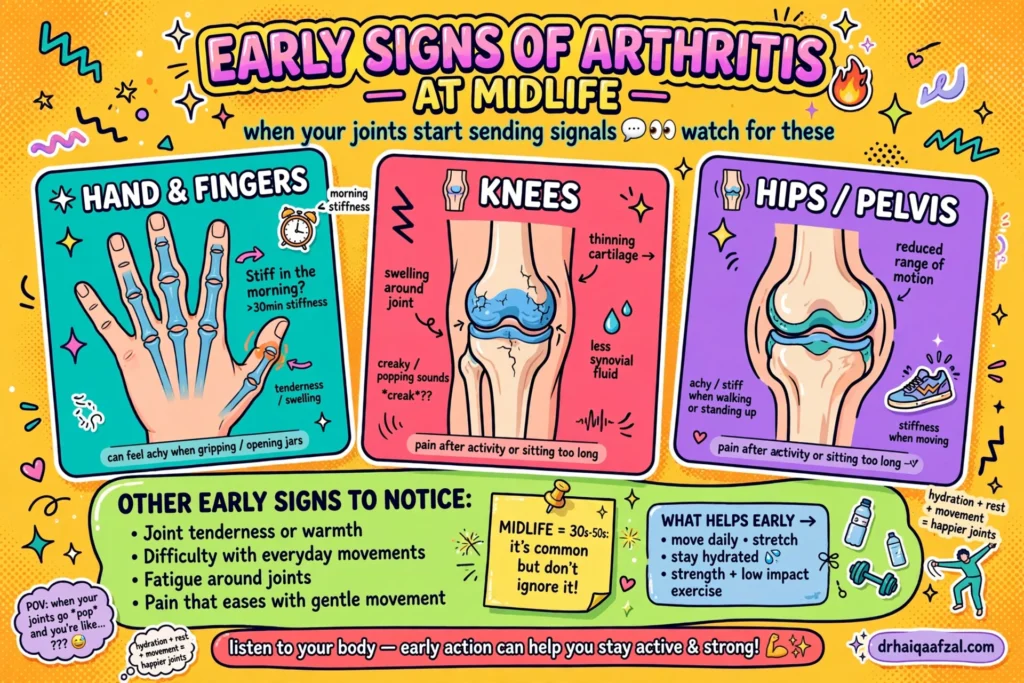
Arthritis in Midlife: Early Signs and When to See Your GP
Early signs of arthritis often appear before a diagnosis: Most people notice their joints changing long before they mention it to a doctor. A knee that stiffens after sitting through a long meeting. Fingers that ache when opening a jar in the morning. A shoulder that grumbles after a weekend of gardening. For many adults in their forties and fifties, these moments raise the same quiet question: is this arthritis, and should I do something about it?
Today is World Arthritis Day 2026, observed every 12 October to raise awareness of rheumatic and musculoskeletal diseases. This year’s EULAR campaign theme is “Achieve Your Dreams”, a reminder that good arthritis care is not only about controlling pain but about helping people keep working, stay active and remain independent. That starts with recognising the early signs and knowing which ones deserve a clinician’s attention.
Arthritis Is Not One Condition
A common misconception is that arthritis is a single disease and a natural part of ageing. Neither is true. The term covers more than 100 different conditions, according to the Arthritis Foundation, and while the risk of the commonest forms rises with age, some inflammatory forms begin much earlier and children can develop arthritis too.
In the United States, nearly 60 million adults and children are diagnosed with at least one form of arthritis, and roughly one in four adults has diagnosed arthritis, the Arthritis Foundation reported ahead of this year’s World Arthritis Day. The two commonest forms are osteoarthritis and rheumatoid arthritis, but gout, psoriatic arthritis and other conditions sit under the same umbrella. Each has different causes, different early signs and different treatment. The first step in good care is therefore to understand which condition is causing the symptoms.
Midlife joint pain can also overlap with other changes of this stage of life; women noticing mood, sleep or temperature changes alongside joint symptoms may find our perimenopause and mental health guide useful context: https://drhaiqaafzal.com/perimenopause-anxiety-low-mood-world-mental-health-day/
Early Signs of Arthritis: Osteoarthritis
Osteoarthritis is the commonest form of arthritis. In osteoarthritis, the protective cartilage covering the ends of bones gradually wears down, and the whole joint, including surrounding tissues, becomes affected. It commonly affects the knees, hips, hands and spine.
The early signs of osteoarthritis tend to follow a recognisable pattern:
- Pain that follows activity. The joint aches during or after use and settles with rest. A knee that complains at the end of a long walk, or hands that ache after gardening, fit this pattern.
- Brief morning stiffness. The joint feels stiff when you first get up but loosens within half an hour of movement.
- Clicking or cracking. A joint that clicks or cracks when it bends can be an early feature, though this alone is rarely significant.
- Swelling after extended use. The joint may swell after a busy day and settle overnight.
- Bony swelling around small joints. Enlargement at the finger joints can appear gradually over months or years.
One feature deserves emphasis because it surprises patients: the National Institute for Health and Care Excellence (NICE) advises that adults aged 45 or over with activity-related joint pain and morning stiffness lasting no longer than 30 minutes can be diagnosed with osteoarthritis clinically, without imaging. An X-ray is not routinely needed to diagnose osteoarthritis, and changes seen on scans correlate poorly with symptoms. NICE reserves imaging for atypical features such as a history of recent trauma, prolonged morning stiffness, rapid worsening, a hot swollen joint, or features suggesting infection.
Early Signs That Point to Inflammatory Arthritis
Some patterns point away from wear and tear and towards an inflammatory condition such as rheumatoid arthritis. These signs deserve a different, faster response:
- Persistent swelling of joints. The joint looks swollen, feels warm or “boggy” on palpation, and the swelling does not settle with rest.
- Morning stiffness lasting more than 30 minutes. Stiffness after inactivity that takes over half an hour to ease is a hallmark of inflammatory disease.
- Symmetrical involvement of small joints. Inflammation affecting the same small joints of both hands or feet, particularly the knuckles or the joints at the base of the toes, is characteristic.
- More than one joint affected. Several joints involved at once is more suspicious than a single joint.
- Systemic features. Fatigue, a low-grade sense of being unwell, or unintended weight loss can accompany inflammatory arthritis. Fatigue can have many causes, including iron deficiency, which is worth investigating in its own right: https://drhaiqaafzal.com/why-heavy-periods-cause-iron-deficiency-women/
The reason for speed matters here. Early treatment of rheumatoid arthritis improves long-term outcomes, physical function and quality of life. NICE guidance (NG100) recommends that any adult with suspected persistent synovitis of undetermined cause be referred for specialist opinion, urgently if the small joints of the hands or feet are affected, more than one joint is affected, or three months or longer have passed since symptoms began: https://www.nice.org.uk/guidance/ng100/chapter/recommendations. NICE’s quality standard sets the bar at referral to a rheumatology service within three working days of presenting in primary care. Even with normal blood tests, referral should not wait for investigations.
Gout and Other Patterns Worth Knowing
Not all midlife joint pain fits the osteoarthritis or rheumatoid arthritis templates. A few other patterns are worth recognising:
- Gout often announces itself suddenly, frequently overnight, with intense pain, redness and swelling in a single joint, classically the big toe. An attack can peak within hours. Gout is caused by urate crystals accumulating in the joint, and it is a treatable condition with clear management guidance.
- Psoriatic arthritis develops in some people with psoriasis and can cause joint swelling, heel pain or changes to the nails. Anyone with psoriasis who develops joint symptoms should mention both to their GP.
- Post-injury or occupational strain can mimic arthritis. A joint injured years ago is more likely to develop osteoarthritis later, and jobs that repeatedly load the same joint accelerate the process.
Red Flags: When Joint Pain Is Urgent
Most arthritis develops slowly, so a sudden change deserves attention. Seek care promptly, including emergency care where indicated, if you notice:
- A joint that becomes hot, red and very swollen over hours, especially with fever or feeling unwell. This can signal a joint infection (septic arthritis), which is an emergency.
- An inability to bear weight on a leg, or a joint that looks deformed after injury.
- A joint that locks and will not straighten or bend.
- New numbness, tingling or weakness in the limb.
- Pain that wakes you regularly at night or has changed in character, and swelling that recurs after each bout of activity.
These patterns are different in kind from the usual fluctuations of osteoarthritis, not merely a worse version of a familiar ache. When in doubt, a call to the surgery or a pharmacist is never wasted.
What Your GP Will Actually Do
Knowing what happens in the appointment removes much of the hesitation. The GP will take a history of the pattern of your symptoms, examine the joints, and ask about family history, injuries, other medical conditions and medicines.
For suspected osteoarthritis in someone aged 45 or over with the typical pattern, the diagnosis is clinical and no scan is needed. For suspected inflammatory arthritis, the GP will arrange blood tests, such as rheumatoid factor, and possibly anti-CCP antibodies and X-rays of the hands and feet, but these investigations should not delay the referral to rheumatology. NICE is explicit on this point: investigations ordered in primary care must not hold up the referral.
After diagnosis, the emphasis for osteoarthritis is on information, exercise and weight management, with medicines and injections as supporting measures, and joint replacement considered only when pain, deformity and loss of function are advanced. Supporting bone and muscle health matters through the darker months too; see our guide on why doctors advise a daily vitamin D supplement from October to March: https://drhaiqaafzal.com/vitamin-d-supplement-autumn-uk-guidance/
When to Book: A Practical Checklist
Use these questions as a guide. Book a GP appointment if any of them are answered yes:
- Has joint pain, swelling or stiffness persisted for more than a few weeks, or does it keep returning?
- Does morning stiffness last longer than 30 minutes?
- Is more than one joint affected, or are the small joints of the hands or feet involved?
- Does the joint still hurt at rest, or do symptoms limit ordinary daily activities?
- Have simple measures such as ice, rest and over-the-counter pain relief stopped helping?
- Has there been a sudden, severe attack of pain in a single joint?
Three months or longer between the onset of symptoms and seeking advice is already considered a delay for suspected inflammatory arthritis under NICE guidance, so earlier is better.
Frequently Asked Questions
Is joint pain in your forties and fifties always arthritis?
No. Joint pain at midlife can come from overuse, old injuries, tendon problems or other conditions, and not every ache is an early sign of arthritis. However, persistent activity-related pain with brief morning stiffness in someone over 45 fits the clinical picture of osteoarthritis, and persistent swelling with prolonged stiffness points towards inflammatory arthritis. A clinical assessment sorts this out.
How long should morning stiffness last before I worry?
Stiffness from osteoarthritis typically loosens within 30 minutes of movement. Stiffness lasting more than 30 minutes after waking or after inactivity is a feature of inflammatory arthritis and is one of the reasons NICE advises urgent referral when it accompanies joint swelling.
Do I need an X-ray or scan to diagnose arthritis?
For osteoarthritis in adults aged 45 or over with the typical pattern, NICE advises diagnosis on clinical grounds without imaging. Scans are reserved for atypical features or where another diagnosis is possible. For suspected rheumatoid arthritis, X-rays of the hands and feet form part of the assessment but do not replace clinical examination and referral.
Can early treatment change the course of rheumatoid arthritis?
Yes. Early diagnosis and treatment of rheumatoid arthritis improves long-term outcomes, physical function and quality of life. Disease-modifying medicines work best when started early, which is why NICE recommends referral to rheumatology within three working days of presentation for suspected persistent synovitis.
What is the difference between osteoarthritis and rheumatoid arthritis?
Osteoarthritis is primarily a degenerative condition of the whole joint, commonly affecting knees, hips, hands and the spine, with pain linked to activity and brief stiffness. Rheumatoid arthritis is an autoimmune disease in which the immune system attacks the joint lining, often symmetrically affecting small joints of the hands and feet, with prolonged stiffness, swelling and potential effects beyond the joints.
When should I see my GP about joint pain?
See your GP if joint pain, swelling or stiffness has persisted for more than a few weeks, morning stiffness lasts longer than 30 minutes, more than one joint is affected, the small joints of the hands or feet are involved, symptoms limit daily activities, or simple measures have stopped helping. Three months or longer between symptom onset and seeking advice is already considered a delay for suspected inflammatory arthritis.
Achieve Your Dreams
The 2026 World Arthritis Day theme, “Achieve Your Dreams”, carries a serious clinical message. People with arthritis have goals beyond their diagnosis: continuing to work, staying active, caring for families, travelling, remaining independent. Achieving that starts earlier than most people think, with recognising the first signs and seeking a proper assessment while treatment can still do its most useful work.
If your joints have been asking questions for weeks or months, this week is as good a time as any to ask a clinician for answers.
This article is for information only and does not replace medical advice. If you are concerned about joint symptoms, speak to your GP or another qualified healthcare professional.