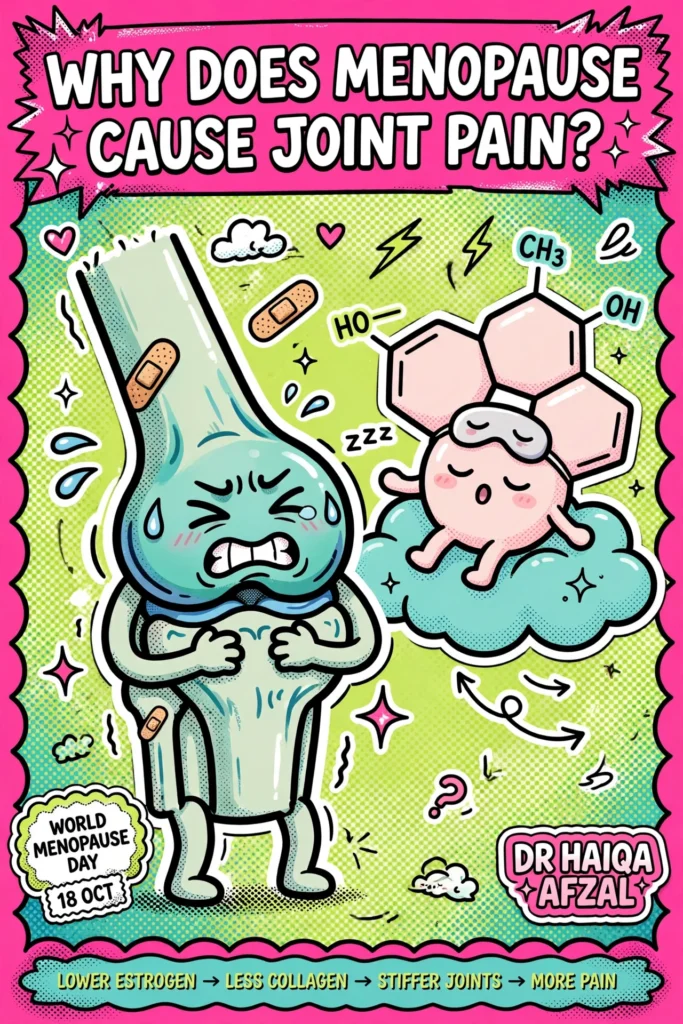
Every October, on the 18th, the world marks World Menopause Day. The International Menopause Society chooses one theme each year to focus research and clinical attention, and for 2026 it has chosen something millions of women already live with every day: chronic pain at midlife.
Aching knees on the stairs. Hands that feel stiff for the first hour of the morning. Shoulders that complain for no clear reason. For many women in their forties and fifties, these symptoms arrive alongside the better-known changes of perimenopause, yet they are rarely discussed in the consulting room with the same seriousness. IMS president Professor Rossella Nappi has said that women’s pain has too often been dismissed through gendered stereotypes and labelled emotional rather than properly investigated and treated. This year’s theme is an attempt to change that conversation.
So why does menopause cause joint pain, and how much of the ache is really down to hormones? The answer is more nuanced than a simple yes or no, and a major 2026 review of the evidence gives us the clearest picture yet.
What the largest review of menopause and joint pain actually found
In early 2026, researchers published what is now the most comprehensive analysis of musculoskeletal symptoms across the menopause transition (Kruse and colleagues, JBJS Open Access). They screened more than 5,500 records and pooled data from 37 observational studies across 22 countries, covering 93,021 women.
The headline figures are striking. Among premenopausal women, about 40% reported muscle or joint pain. Among perimenopausal women, that figure rose to 57%. Among postmenopausal women, it was 59%. Compared with premenopausal women, the risk of muscle or joint pain was 1.35 times higher in perimenopause and 1.40 times higher after menopause. In absolute terms, that means roughly 130 to 148 additional women in every 1,000 experiencing pain after the transition begins.
Those numbers deserve a careful reading. Most of the included studies were cross-sectional, meaning they captured a snapshot in time rather than following women over years. Only two were prospective cohort studies. The studies varied widely in how they measured pain and in the populations they recruited, which is why the statistical heterogeneity was high. Observational research can show that pain rises around the menopause transition, but it cannot by itself prove that falling hormones cause it. Age itself is a competing explanation: joints also accumulate wear and tear in the forties and fifties for reasons that have nothing to do with oestrogen.
The review authors were equally honest about what is missing. Specific musculoskeletal diagnoses, the named conditions rather than the generic label of muscle or joint pain, were poorly characterised and underreported across the studies. That is precisely the evidence gap this year’s World Menopause Day theme is trying to close.
Why falling oestrogen can make joints ache
Even without proof of causation, there are plausible biological reasons for the link. Oestrogen receptors are present throughout the musculoskeletal system, in muscle, tendon, ligament, cartilage and bone. Oestrogen plays a role in collagen production, tissue elasticity, the regulation of inflammation and recovery after mechanical stress. When levels fluctuate and then fall, these systems change, and pain may be one of the first signals.
Animal studies have shown that reduced oestrogen adversely affects joint cartilage and the synovial tissue that lines joints. In humans, the picture is less complete, but longitudinal research points in the same direction. A cohort study of more than 600 women in an urban Chinese community found that both the prevalence and the severity of muscle and joint pain increased as women moved through the stages of the menopause transition.
There is one important nuance worth keeping. A prospective investigation from the Seattle Midlife Women’s Health Study reported a significant increase in back pain during the menopausal transition, whereas joint pain appeared to increase primarily with age rather than with menopause-related factors. That finding does not contradict the larger review, but it is a reminder that midlife pain is rarely down to a single cause. Hormones, ageing, previous injuries, weight, activity levels and sleep all contribute, and good care means sorting out which ones matter most for the individual woman.
The patterns clinicians see in midlife
In practice, menopause-related musculoskeletal symptoms tend to follow recognisable patterns. Many women describe morning stiffness that eases as the day goes on, aching in the small joints of the hands and fingers, soreness in the shoulders, hips or knees, and a general sense of muscles that recover more slowly after activity. Frozen shoulder, carpal tunnel-type tingling in the hands and irritated tendons, such as tennis elbow or plantar fascia pain, are also reported in this age group, although the research characterising these specific conditions across the transition remains thin.
What matters clinically is not the label but the trajectory. Pain that appears gradually across the perimenopause years, moves between joints, fluctuates with other symptoms such as poor sleep or low mood, and responds to movement rather than rest has a different character from pain that starts suddenly in one joint and never shifts. A good history can usually tell these apart, which is why describing the pattern matters more than tolerating it in silence.
Why this symptom was overlooked for so long
Part of the reason menopause-related joint pain stayed in the shadows is structural. The well-recognised clinical guidance on menopause has traditionally focused on vasomotor symptoms such as hot flushes, genitourinary symptoms, mood, sleep and sexual health. Musculoskeletal symptoms were not included in those frameworks, and as the 2026 review notes, recently published summaries of menopausal symptoms have also left them out. When the guidance does not name a symptom, clinicians are less likely to ask about it, and women are less likely to connect it with their changing hormones.
There is also the old reflex of attributing everything in midlife to ageing. Pain that would prompt investigation in a 30-year-old can be waved away as normal wear and tear in a 52-year-old. As this year’s World Menopause Day theme insists, a dismissive label is not a diagnosis. Pain at midlife deserves the same careful assessment as pain at any other age, and a clear scan or blood test does not make real pain imaginary.
Not every midlife ache is the menopause
Conservative clinical care starts with the recognition that hormones are only one possible explanation. Several other conditions become more common in the same decade, and missing them matters.
Osteoarthritis accelerates in midlife as cartilage loses some of its protective environment, and it typically affects the knees, hips, hands and spine. Inflammatory arthritis, including rheumatoid arthritis, can also emerge or worsen after menopause; it tends to cause symmetric joint swelling and morning stiffness that lasts well over half an hour. Polymyalgia rheumatica, a condition of people over 50, causes pain and marked stiffness in the shoulder and hip girdles and needs prompt treatment. An underactive thyroid can present with muscle aches, fatigue and joint stiffness. Low vitamin D, fibromyalgia, frozen shoulder and carpal tunnel syndrome all belong on the list of possibilities, as do medication effects, since drugs such as statins are commonly started in this age group and can cause muscle symptoms.
Red flags that should prompt prompt medical attention include a hot, swollen joint, pain following an injury, joint deformity, fever alongside joint pain, numbness or weakness, severe morning stiffness, shoulder and hip girdle pain with systemic symptoms, and any unexplained weight loss or night sweats alongside the pain. These are not features of uncomplicated menopause-related aches, and they should not be waited out.
When to see your GP, and what happens next
It is worth booking an appointment if joint or muscle pain persists for more than a few weeks, interferes with sleep, work or the activities you enjoy, is accompanied by swelling or significant stiffness, or is getting worse rather than settling. Bringing a short note about when the pain started, which joints are involved, what makes it better or worse, and how long morning stiffness lasts will make the consultation far more useful.
Assessment usually starts with a careful history and examination. Depending on the pattern, your GP may arrange blood tests, such as markers of inflammation, rheumatoid factor or anti-CCP antibodies, thyroid function or vitamin D, and imaging such as an X-ray or ultrasound of the affected joints. In women over 45, the menopause itself is usually diagnosed clinically from symptoms, without the need for blood tests, and joint symptoms can be considered alongside the wider picture. If the pattern suggests inflammatory arthritis, referral to rheumatology should be prompt, because early treatment changes outcomes.
It is also worth mentioning the wider symptom context. Perimenopause can reshape mood, sleep and concentration as well as joints, and these symptoms interact: poor sleep lowers pain thresholds, and persistent pain disrupts sleep. Treating the whole picture usually works better than chasing each symptom separately.
What helps, and what to discuss with your clinician
Regular movement is the single most reliable intervention for aching midlife joints. Gentle, consistent activity, strength training to support the muscles around vulnerable joints, and maintaining a healthy weight all reduce the load on cartilage and improve function. Sleep matters too, because fragmented sleep amplifies pain, and the two feed each other in a cycle worth breaking deliberately.
Hormone replacement therapy is often raised as a possible treatment for menopause-related joint pain. The honest clinical position is that the evidence for HRT specifically relieving musculoskeletal symptoms is limited and mixed, and it should not be presented as a guaranteed fix. HRT is firmly established as effective for vasomotor symptoms and for bone protection, and some women do report improvement in aches, but the decision involves individual risks and benefits that need a proper discussion with a clinician. This Saturday, on the eve of World Menopause Day, we will publish a companion piece examining what the evidence says actually helps midlife joint pain, from HRT research to exercise, so this is a question we will return to in depth.
Supplements are a common question. Vitamin D supplementation from October to March is standard UK guidance for bone health in the darker months, but there is no strong evidence that it relieves joint pain on its own. Collagen powders, turmeric and similar products have thin evidence at best. Money is usually better spent on good footwear, a strength programme and a thorough assessment.
The question to carry into World Menopause Day
The International Menopause Society chose chronic pain at midlife as the 2026 theme for a reason. Pain that is real, common and treatable should not need to be endured quietly, explained away as ageing or labelled as something it is not. The evidence now shows, with unusual clarity, that musculoskeletal pain rises across the menopause transition. What the evidence cannot yet do is name every woman’s pain precisely or prove exactly how much of it is hormonal. That is the work ahead, for researchers and for clinicians.
If this year’s theme leaves you with one action, let it be this: describe your pain, insist it is assessed, and do not accept dismissal as a diagnosis. Your joints, and the rest of you, deserve better than that.
Frequently asked questions
Why does menopause cause joint pain?
Falling oestrogen levels during perimenopause and menopause appear to affect the tissues that support joints. Oestrogen receptors are found in muscle, tendon, cartilage and bone, and oestrogen influences collagen production, inflammation and tissue repair. A 2026 systematic review of 93,021 women found muscle or joint pain in 57% of perimenopausal and 59% of postmenopausal women, compared with 40% before the transition. The evidence is observational, so hormones are a plausible contributor rather than a proven sole cause, and age-related wear and tear plays a part too.
How common is joint pain during menopause?
Very common. A 2026 systematic review and meta-analysis of 37 studies across 22 countries found that 57% of perimenopausal women and 59% of postmenopausal women reported muscle or joint pain, versus 40% of premenopausal women. That represents roughly a 35 to 40% increased risk across the transition.
Is morning stiffness a menopause symptom?
Morning stiffness is frequently reported by women in perimenopause and often eases as the day goes on. However, stiffness lasting well over half an hour, especially with swollen joints, can signal inflammatory arthritis and should be assessed promptly rather than assumed to be hormonal.
When should I see a GP about joint pain at midlife?
See your GP if pain persists for more than a few weeks, disrupts sleep or daily activities, involves swelling or significant stiffness, or is worsening. Seek prompt attention for a hot swollen joint, pain after injury, joint deformity, fever with joint pain, numbness or weakness, or severe shoulder and hip girdle stiffness.
Does HRT help menopause joint pain?
The evidence is limited and mixed. HRT is well established for hot flushes and bone protection, and some women report less aching, but it is not a proven treatment for joint pain specifically. The decision involves individual risks and benefits and should be discussed with a clinician.
What is the World Menopause Day 2026 theme?
The International Menopause Society has named chronic pain at midlife as the theme of World Menopause Day 2026, observed on 18 October. The campaign calls for better recognition, assessment and evidence-based care of persistent pain during and after the menopause transition.
Sources
- International Menopause Society: World Menopause Day 2026 theme, Chronic Pain at Midlife.
- Kruse C, McKechnie T, Dworsky-Fried J, et al. Musculoskeletal Manifestations of Perimenopause: A Systematic Review and Meta-Analysis of 93,021 Women. JBJS Open Access. 2026;11(1). DOI: 10.2106/JBJS.OA.25.00254.
- National Institute for Health and Care Excellence. Menopause: diagnosis and management. NICE guideline NG23.
- Seattle Midlife Women’s Health Study, as summarised in Kruse et al. 2026.
- IMS White Paper statement on World Menopause Day 2026 (via published summaries quoting IMS president Professor Rossella Nappi).