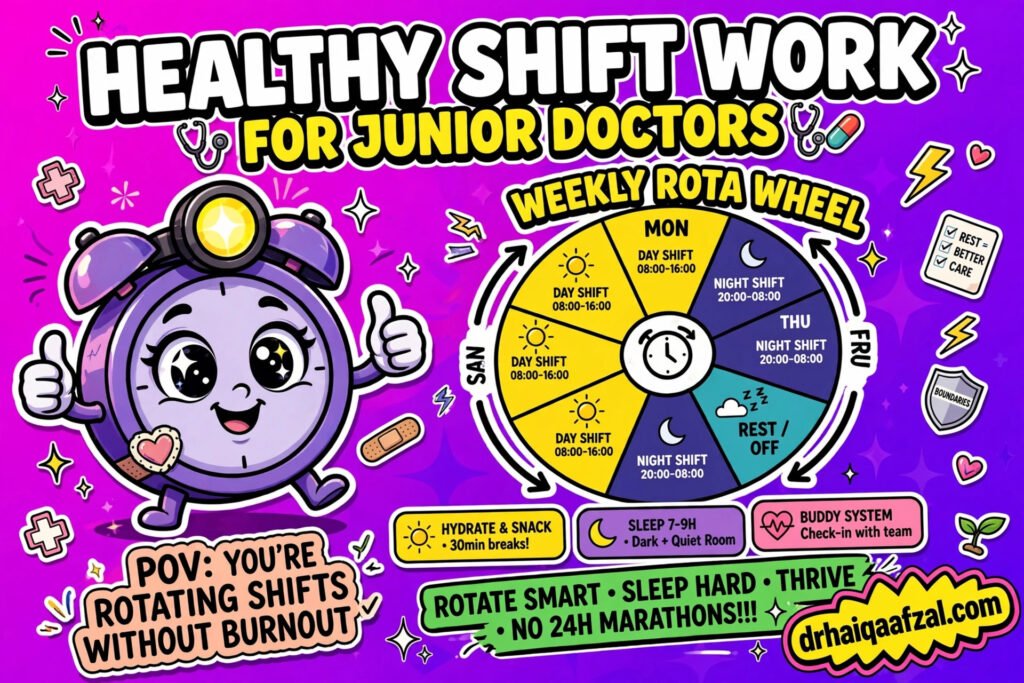
Night shifts are the part of the rota junior doctors dread most, and the research says that dread is well founded. Sleep loss changes how the brain works long before you feel unsafe, and the way shifts are sequenced changes the damage by a wide margin. So what is the healthiest shift work schedule? The evidence converges on a clear answer: shifts of 10 to 12 hours, rotating forward from days to evenings to nights, no more than four nights in a row, at least 46 hours off after a run of nights, and at least 16 hours between shifts. No rota removes the risks of night work entirely, but a rota built on these rules is measurably safer for patients and kinder to the doctors working it.
The short answer: The healthiest shift work schedule keeps individual shifts to 10 to 12 hours, rotates forward (mornings, then afternoons, then nights), limits consecutive night shifts to four with at least 46 hours of recovery afterwards, allows a minimum of 16 hours off between shifts, and protects sleep with planned naps during night shifts. Rapid forward rotation, worker input into the rota, and predictable rest all improve tolerance. These are the rules supported by the research, and they also form the backbone of current UK junior doctor rostering guidance.
Why rota design matters more than willpower
Fatigue is physiology, not weakness. In a landmark study published in Nature in 1997, Dawson and Reid showed that 17 to 19 hours of sustained wakefulness impaired reaction-time performance as much as a blood alcohol concentration of 0.05 percent, and that 24 hours without sleep was equivalent to around 0.10 percent. By the end of a long night on call, many doctors are performing at the level of someone over the drink-drive limit, whatever their intentions.
The patient-safety consequences are not theoretical. In two linked studies published in the New England Journal of Medicine in 2004, Landrigan and colleagues compared interns working traditional 30-hour shifts with interns whose work was limited to 16 consecutive hours. Those on the traditional schedule made 36 percent more serious medical errors, five times as many serious diagnostic errors, and 21 percent more serious medication errors. A companion study by Lockley and colleagues found twice the rate of attentional failures on the longer shifts. Most errors were caught by nurses, pharmacists and senior staff before permanent harm was done, but the system was clearly absorbing risk that better rostering would have prevented.
That is why the question of the healthiest shift work schedule is a clinical question, not a lifestyle one. Rota design is a safety intervention.
What “healthiest” actually means for shift workers
Researchers judge shift schedules on three things. First, immediate performance: attention, reaction time and error rates during the shift. Second, sleep and recovery: how much sleep debt accumulates across a run of shifts and whether rest days repay it. Third, long-term health: the epidemiological links between years of night work and disease.
On that third measure the evidence deserves honesty. A BMJ review of shift work in junior doctors summarised studies linking shift work with higher risks of peptic ulcers, diabetes and coronary heart disease. Danish researchers estimated that up to a fifth of the country’s cardiovascular disease could be prevented if psychosocial risk factors including shift work were absent. A Danish case-control study found a 50 percent increase in breast cancer risk among women working regular night shifts, and a cohort study of American nurses found coronary heart disease risk rising with the number of years of shift work, with six or more years of nights significantly increasing cardiovascular risk. These are observational associations, not proof of causation, and most studied industrial shift workers rather than doctors. But they set the stakes: the healthiest schedule is the one that minimises disruption across all three measures, not just the one that feels tolerable.
The five evidence-backed rules of a healthy rota
Drawing on reviews of the rostering literature, including the Royal College of Physicians’ work on safer rotas and the BMA’s Fatigue and Facilities charter, the rules below are the ones with the strongest support. They are also, in large part, what UK junior doctor contracts now require.
1. Rotate forward, not backward
The human body clock delays more easily than it advances, so schedules that move from mornings to afternoons to nights, a clockwise or forward rotation, are better tolerated than the reverse. The BMJ’s evidence-based rostering review recommends rapid forward rotation, changing every few days rather than every day or every fortnight. A slow backward rotation fights the circadian system on every transition; a fast forward one works with its natural tendency to drift later.
2. Cap consecutive nights at four, then recover properly
Sleep deprivation accumulates across consecutive night shifts, with performance worsening day by day. The Royal College of Physicians recommended limiting consecutive nights to a maximum of four, noting that single night shifts are safest. The 2016 junior doctor contract in England turned that recommendation into a rule: a maximum of four consecutive night shifts, down from seven, with at least 46 hours of rest after a run of three or four nights. A later joint review by the BMA and NHS Employers went further, applying the 46-hour rest period after any rostered night shifts. The BMA’s Fatigue and Facilities charter makes the same point in rostering terms: rotas must allow adequate recovery after nights so normal sleep patterns can re-establish, at least 46 hours after the final night shift.
3. Keep shifts to 10 to 12 hours and watch the weekly total
The rostering literature recommends individual shifts of no more than 10 to 12 hours. The BMA charter adds the wider constraints used in good rota design: no more than four long shifts in a row, a maximum of seven consecutive shifts of any kind, and no more than 72 hours worked in any 168-hour period. Quick returns, an evening shift followed by an early morning start, are among the most damaging patterns because they compress the sleep window from both ends; one review recommends a minimum of 16 hours off duty between shifts to allow at least 7 hours of sleep.
4. Protect sleep as part of the rota, not as an afterthought
The healthiest schedules build recovery into the design. Structured naps during the night shift, supported by proper rest facilities, measurably compensate for sleep loss, and access to a private room to sleep after a night shift reduces the risk of driving home drowsy. Under the 2016 terms, junior doctors are entitled to at least one 30-minute paid break on shifts over five hours and a second on shifts over nine hours, and the charter supports bleep filtering and a hospital-at-night approach so those breaks actually happen. Strategic caffeine and bright light during the shift can help, though the evidence for any single countermeasure is modest; the planned nap is the intervention with the best support.
5. Give doctors a say and keep the pattern predictable
Workers who participate in designing their shift pattern tolerate it better, and predictable rotas with leave that can actually be taken reduce the strain of shift work on the rest of life. The BMA and NHS Employers’ good rostering guidance emphasises balanced rota cycles, with different shift types evenly distributed to manage fatigue, rather than lopsided rotas that bunch the hardest shifts together. Rota design is a team sport: the best rotas are negotiated, not imposed.
What you can control when the rota is fixed
Junior doctors rarely design their own rotas, so the honest question is what helps on a bad one. The evidence points to a short list. Nap before a night shift and, if facilities allow, during it; the pre-night nap was part of the intervention schedule that cut serious errors in the Landrigan study. Time caffeine for the first half of the shift and avoid it in the final hours so it does not wreck the morning sleep. Use bright light through the night and sunglasses on the commute home to protect the day sleep. Make the bedroom dark, cool and quiet, and treat earplugs and an eye mask as clinical equipment. Never drive drowsy after nights; use the on-call room instead. And hand over cleanly: the most error-prone work is complex decision-making at the end of a deprived shift, so that is the work to defer or double-check.
Two related questions are worth reading alongside this one: whether working night shifts affects your lifespan, which reviews the long-term evidence, and how many hours of sleep you need after a night shift, which covers recovery in detail.
When your rota breaks the rules
In England, the contractual limits are not suggestions. If your rota regularly breaches them, log the facts and use exception reporting: it is the formal mechanism for flagging unsafe working patterns, and it is how rota problems become visible to the people who can fix them. Every trust also has a guardian of safe working hours whose job is to intervene on exactly this. The BMA charter is explicit that emergency requests for cover must stay within the same limits as the rota itself, so a staffing gap does not make a fifth long shift acceptable. Raising a rota concern is a patient-safety act, and the system has channels built for it.
Frequently asked questions
Is four nights in a row safe?
Four consecutive nights is the contractual ceiling in England, not the ideal. The Royal College of Physicians noted that single night shifts are safest, and performance declines across consecutive nights as sleep debt accumulates. What the evidence supports is capping the run at four and following it with at least 46 hours of recovery, which is now the rule in the junior doctor contract.
Is a permanent night shift healthier than rotating?
The evidence is mixed. Permanent nights allow partial circadian adaptation, which some workers prefer, but long-term health associations with night work persist regardless of schedule type, and permanent nights carry heavy social costs. Rapid forward rotation is generally better tolerated than slow or backward rotation, and most rostering guidance favours well-designed rotating schedules.
How much time off do I need between shifts?
One review of the evidence recommends a minimum of 16 hours off duty between shifts to allow at least 7 hours of sleep. Shorter turnarounds, especially quick returns from evening to morning shifts, compress the sleep window and are among the patterns most strongly linked to fatigue-related harm.
Does shift work cause lasting health damage?
Observational studies link years of night shift work with higher risks of cardiovascular disease, metabolic disorders and, in some studies, breast cancer, but these are associations rather than proven causation, and good rota design reduces the exposure that drives them. The long-term evidence is reviewed in our piece on whether night shifts affect lifespan.
What should I do if my rota regularly breaches the limits?
Keep a factual log and submit an exception report, which is the formal channel for unsafe working patterns in England, and contact your trust’s guardian of safe working hours. The BMA’s guidance is clear that cover requests must stay within contractual limits too, so a rota gap does not justify a fifth consecutive long shift.
Sources
- Ahmed-Little Y. Implications of shift work for junior doctors. BMJ. 2007;334(7597):777-778. Full text at PubMed Central
- Landrigan CP et al. Effect of reducing interns’ work hours on serious medical errors in intensive care units. N Engl J Med. 2004;351:1838-1848. AHRQ research summary
- Dawson D, Reid K. Fatigue, alcohol and performance impairment. Nature. 1997;388(6642):235.
- BMA Fatigue and Facilities Charter: rostering and rota design. Charter document (PDF)
- House of Commons written question 270697: junior doctors’ working hours and the 2016 contract limits. Parliament record
This article is for general information only and is not medical advice. Junior doctors with concerns about fatigue, sleep or their working pattern should speak to their educational supervisor, occupational health department or GP.