Why Do GP Surgeries Get Busier After the Clocks Go Back?
Do clocks going back affect health? The short answer from the largest English study of the question is yes, but not in the direction most people expect. In the week after the autumn clock change, recorded health events for anxiety, depression, acute cardiovascular disease, psychiatric emergencies and sleep disorders fell slightly, rather than rising. So if your GP surgery feels busier in late October, the clock change itself is probably not the reason, at least not in that first week.
That finding comes from a population based study of 683,809 people in England, published in the BMJ in 2025. It is the most complete picture yet of what the clock change does to demand for health services, because it used 12 years of general practice and hospital records rather than a survey or a single hospital. The honest clinical message is more subtle than “the clocks make us ill” or “the clocks make us well”. For one week, demand for help with five conditions dipped. Everything else about late autumn, from darker evenings to flu season, is a separate story.
What changed this weekend
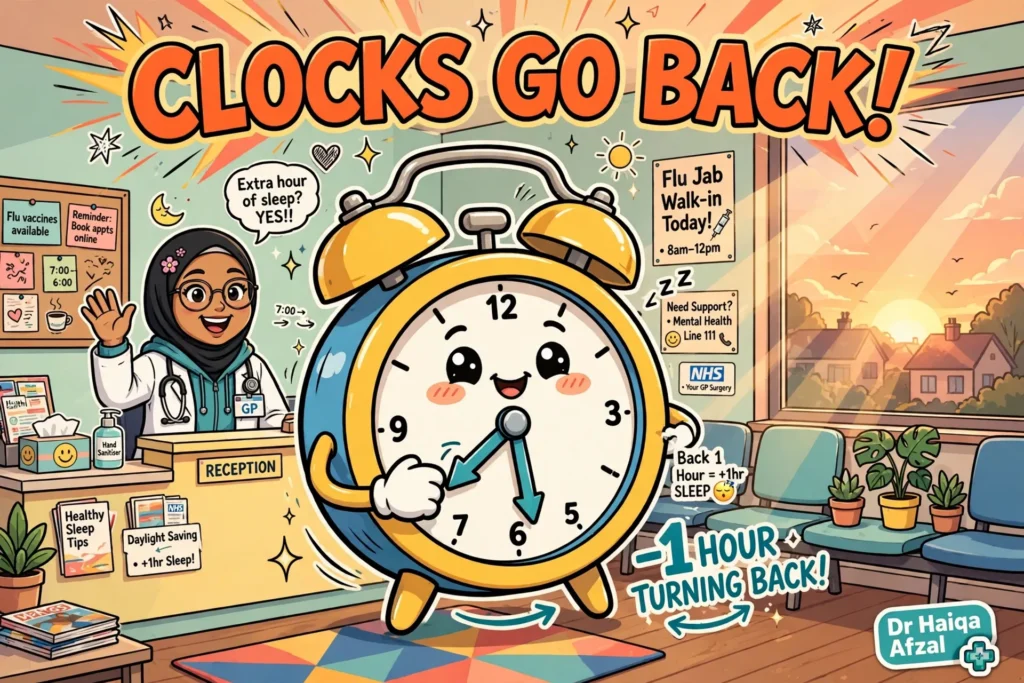
At 2am on Sunday 25 October 2026, British Summer Time ended and the clocks went back one hour to 1am Greenwich Mean Time. Mornings are lighter from today, evenings are darker, and the UK stays on Greenwich Mean Time until the clocks go forward again on 28 March 2027.
The autumn change is the one people usually welcome, because it appears to hand back an hour. The evidence says the extra hour is real but smaller than the full 60 minutes. In a separate UK Biobank study using wrist worn activity monitors, people slept on average 33 minutes longer on the autumn clock change Sunday than on the Sunday before. That study followed 11,780 adults aged 43 to 78, and its autumn result is one of the few objectively measured sleep findings in this debate, rather than a self reported estimate.
What the 683,809 person study found
The BMJ study, led by Melanie de Lange at the University of Bristol, looked at English primary care practices contributing to the Clinical Practice Research Datalink GOLD database, linked to hospital admissions and accident and emergency data. It included everyone who had a health event for one of the conditions of interest in the eight weeks around the spring or autumn clock changes between 2008 and 2019: 683,809 people in total.
Researchers compared the mean daily number of events in the first week after each clock change with a control period made up of the four weeks before the change and weeks two to four after it. In the week after the autumn clock change, five conditions had fewer recorded events:
- Anxiety: down 3 per cent, from 17.3 events per day to 16.7 (per year, per region)
- Acute cardiovascular disease: down 2 per cent, from 50.0 to 48.9
- Depression: down 4 per cent, from 44.6 to 42.7
- Psychiatric conditions presenting to accident and emergency: down 6 per cent, from 3.5 to 3.3
- Sleep disorders: down 8 per cent, from 5.4 to 4.9
The reductions were modest, but they were statistically significant, and the sleep disorder reduction persisted for up to four weeks, weakening over time. By contrast, the study found little evidence of reductions in eating disorder diagnoses, road traffic injuries or self harm, and little evidence of any change at all after the spring clock change, when an hour is lost rather than gained.
Why researchers think the autumn change helps, briefly
The researchers suggest two mechanisms, and both are plausible rather than proven. The first is the extra sleep itself: even 33 minutes more on the change night, with some catch up sleep on the days after, may be enough to tip a small number of people away from seeking help that week. The second is the abrupt increase in morning sunlight. After the clocks go back, mornings are suddenly lighter at the same clock time, and morning light helps reset a body clock that naturally runs slightly longer than 24 hours. Better aligned sleep supports mood, and the researchers note that morning light may also lower cardiovascular risk by reducing blood pressure.
That mechanism also explains why the spring change looks different. Losing an hour in spring cuts sleep on the change Sunday by 65 minutes on average in the UK Biobank data, yet the BMJ study found little evidence of a corresponding rise in recorded events the following week. Sleep loss and recorded demand do not move in lockstep, which is a useful reminder that health service data measures people seeking help, not every symptom people experience.
What the study does not prove
This is an observational study, so no firm conclusions can be drawn about cause and effect. That caveat matters more than usual here, for three reasons.
First, the records contain only events for which a person sought medical help. Someone who felt anxious but did not contact a clinician is invisible in this data. Second, the date in the record is the date a clinician recorded the event, which is not necessarily the date symptoms began. A person who struggled all week and booked an appointment the following Monday would appear in the later week. Third, the comparison is between weeks, not between people who did and did not experience a clock change, because everyone in England experiences it together. There is no unexposed control group.
As de Lange herself put it: “Our study contributes to the ongoing debate about England’s clock change policy. Future research should explore the mechanisms underlying the reduction in health events that we observed after the autumn clock change.” That is the right level of confidence: an intriguing, well measured association, not a prescription.
So why do surgeries feel busier in late October?
Here the study and everyday experience part company, and the distinction is worth making clearly. The study measures recorded health events for specific conditions in the first week after the change. It does not measure how many people rang a surgery, how long they waited, or how full the appointment book looked. A surgery can feel busier while recorded events for anxiety and depression dip, because the two things are not the same measure.
Late October also brings pressures that have nothing to do with the clock change. Flu season builds through the autumn, which is why the vaccination programme runs from September and October: you can check who is eligible for a free flu jab this winter and who should get the COVID-19 booster this autumn in our recent guides. Darker evenings affect mood and routine for many people as winter sets in, and cold weather brings its own coughs, colds and aches. None of that contradicts the BMJ finding. It simply means the first week after the clocks go back is not the same thing as the whole of late autumn.
There is one more honest possibility. The week after the change may look quieter in the records partly because people postpone routine appointments around a disrupted weekend, or because the extra hour itself changes when people choose to seek help. The study cannot rule that out. What it can say is that, for the five conditions studied, the feared surge in demand in the week after the autumn change did not appear in 12 years of English records.
Making the change work for you this week
Whatever the population data shows, individuals vary, and a disrupted weekend can still leave you groggy. A few practical steps help most people settle back into rhythm within a few days:
- Keep the same wake time every day this week, even if you went to bed later. A fixed wake time anchors the body clock faster than a lie in.
- Get outside in the morning. Daylight in the first hour after waking is the strongest signal that resets your internal clock, and mornings are now lighter.
- Keep evenings calm and dim in the last hour before bed, so the darker evenings work for your sleep rather than against it.
- If sleep is your main struggle, our guide on does low iron affect your sleep covers a commonly missed medical cause of restless nights that is worth ruling out before blaming the clocks.
Most people adjust within a few days. If low mood, anxiety or broken sleep persists for weeks rather than days, or starts to interfere with work and relationships, that is worth a GP appointment in its own right, whatever the calendar says.
When to seek help promptly
Clock changes never explain away urgent symptoms. Call 999 for signs of a stroke (face drooping, arm weakness, speech difficulty), chest pain, severe breathlessness or any symptom that feels like an emergency. Contact your GP promptly for persistent low mood, anxiety that is getting worse, or sleep problems that last more than a few weeks. Do not wait for the next clock change to see whether things improve on their own.
Sources
- de Lange MA et al. Acute effects of daylight saving time clock changes on mental and physical health in England: population based retrospective cohort study. BMJ 2025;391. bmj.com
- University of Bristol. Autumn clock change linked to reduction in certain health conditions. bristol.ac.uk
- de Lange MA et al. The effects of daylight saving time clock changes on accelerometer measured sleep duration in the UK Biobank. Journal of Sleep Research 2025;34:e14335. ukbiobank.ac.uk