The short answer
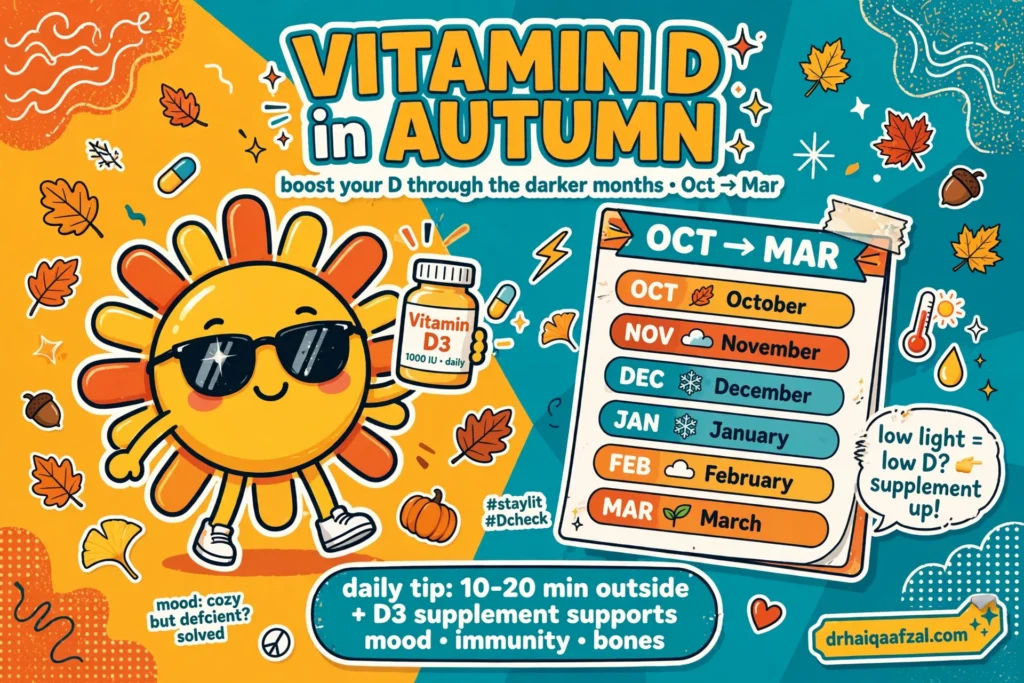
Do you need a vitamin D supplement in autumn in the UK? For most people, yes, it is worth considering. NHS guidance advises that between October and early March, sunlight in the UK is not strong enough for the skin to make sufficient vitamin D. Adults and children over four are therefore advised to consider a daily supplement containing 10 micrograms of vitamin D, which is the same as 400 international units, or IU, throughout autumn and winter.
This is one of the few supplement recommendations that applies to almost the whole population, and it exists for a simple reason: vitamin D is difficult to obtain in sufficient amounts from food alone, and for roughly half the year the UK sun cannot fill the gap. A small daily supplement is a practical way to maintain levels when sunlight is limited.
This article explains why the advice is seasonal, who should consider vitamin D all year round, what the research does and does not show about infections, and how to take a supplement safely without taking too much.
Why does vitamin D advice change in October?
Vitamin D is made in the skin when it is exposed to ultraviolet B rays from sunlight. In the UK, the sun sits too low in the sky during autumn and winter for this process to work effectively. From October to early March, even a bright day does not provide the conditions the skin needs to produce meaningful amounts of vitamin D.
Between late March or early April and the end of September, most people can make the vitamin D they need through sunlight on the skin, alongside a balanced diet. That is why the supplement advice is switched on in October and switched off again in spring, rather than applying all year to everyone.
Cloud cover, time spent indoors, clothing and sunscreen use all reduce skin synthesis further. If your working day begins and ends in the dark during winter, as it does for many people in the UK, your skin may make almost no vitamin D for several months.
What does vitamin D actually do?
Vitamin D helps regulate the amount of calcium and phosphate in the body. These nutrients are needed to keep bones, teeth and muscles healthy. This is not a minor or fashionable claim: it is the established role on which UK dietary recommendations are based.
When vitamin D levels fall too low for too long, bone health suffers. In children, severe deficiency can lead to bone deformities such as rickets. In adults, it can cause osteomalacia, a condition in which bones become soft and painful. Muscle weakness and bone pain can also occur, and these symptoms are sometimes mistakenly attributed to ageing, overwork or low mood.
The Scientific Advisory Committee on Nutrition, whose 2016 report underpins current UK advice, concluded that the risk of poor musculoskeletal health increases at blood vitamin D concentrations below 25 nanomoles per litre. The UK recommendation of 10 micrograms a day was set to keep almost the whole population above that level through the winter months, when sunlight contributes little or nothing.
Who should consider vitamin D all year round?
The October to March advice applies to the general population. Some people, however, are advised to consider a daily 10 microgram supplement throughout the year, because they may not make enough vitamin D from sunlight even in spring and summer. NHS guidance identifies these groups:
- People who are not often outdoors, for example those who are frail or housebound.
- People who live in an institution such as a care home.
- People who usually wear clothes that cover up most of their skin when outdoors.
- People with dark skin, including people from African, African-Caribbean and South Asian backgrounds, who may not make enough vitamin D from sunlight.
If one of these descriptions applies to you, the seasonal switch-off in March does not apply in the same way, and year-round supplementation is worth discussing with your pharmacist or GP.
What about babies and children?
Children have their own recommendations, and adult supplements should not simply be given to them. Under UK guidance:
- Babies and young children need age-appropriate vitamin supplements. Children aged one to four are advised to have a daily supplement throughout the year.
- Babies who are having more than 500 millilitres of infant formula a day do not need a separate vitamin D supplement, because formula is already fortified.
- Everyone aged over four, including pregnant and breastfeeding women, is covered by the advice to consider 10 micrograms a day during autumn and winter.
If you are unsure which product is suitable for your child, a pharmacist, health visitor or GP can advise. Some families are entitled to free vitamin supplements through the Healthy Start scheme.
Does vitamin D protect against chest infections?
This is where careful reading matters, because the headlines often run ahead of the evidence. Vitamin D is thought to play a role in immune function, and researchers have been examining whether low levels are connected to more serious respiratory infections.
A large analysis led by the University of Surrey, published in The American Journal of Clinical Nutrition, examined data from 36,258 adults in the UK Biobank cohort. The researchers found that people with severe vitamin D deficiency, defined as a blood level below 15 nanomoles per litre, had a 33 percent higher rate of hospital admission for respiratory tract infections such as bronchitis and pneumonia, compared with people whose levels were at least 75 nanomoles per litre. They also found that for each 10 nanomole per litre increase in vitamin D level, the hospital admission rate fell by about 4 percent.
These are interesting and potentially important findings, but it is essential to be precise about what they show. This was an observational analysis: it found an association between low vitamin D levels and higher admission rates. It does not prove that low vitamin D caused the admissions, and it does not prove that taking a supplement will prevent a chest infection or keep you out of hospital. People with severe deficiency often differ from people with sufficient levels in other ways that affect their health.
The reasonable conclusion is a modest one. Avoiding severe deficiency is sensible for bone and muscle health, and the infection data add to the case for not letting levels fall very low over winter. That is a good reason to follow the established 10 microgram guidance. It is not a reason to take very large doses in the hope of avoiding winter viruses, and it does not replace vaccination, ventilation, or seeking care promptly if you become unwell.
Can you get enough vitamin D from food?
Only a small number of foods naturally contain vitamin D. The main sources are oily fish such as salmon, sardines, herring and mackerel, along with egg yolks, red meat and liver. Some foods are fortified, including certain breakfast cereals, fat spreads and yoghurts.
In practice, it is difficult to obtain enough vitamin D from diet alone, particularly in autumn and winter. Food remains valuable as part of a balanced diet, and oily fish brings other nutritional benefits, but diet by itself is not considered a reliable way to maintain vitamin D levels through a British winter. That is precisely why the supplement recommendation exists.
How do you choose and take a supplement?
For most adults, choosing a supplement is straightforward. Look for a product that provides 10 micrograms, or 400 IU, of vitamin D per daily dose. More is not automatically better, and a higher number on the front of the bottle does not mean stronger protection.
A few practical points help:
- Check the dose per serving. Sprays, gummies, drops and capsules are labelled differently. Confirm whether the stated amount is per drop, per capsule or per full daily serving.
- Check for duplication. If you also take a multivitamin or an immune-support product, add up the vitamin D from all sources. Duplication is the commonest route to taking far more than intended.
- Take it consistently. A daily routine, for example with breakfast, matters more than the exact hour.
- Ask if you are unsure. Pharmacists are well placed to check a product against your other medicines and health conditions.
Can you take too much vitamin D?
Yes. Vitamin D is a fat-soluble vitamin, and taking too much over a long period can cause calcium to build up in the body, a condition called hypercalcaemia. This can weaken the bones and damage the kidneys and heart.
NHS guidance sets clear upper limits for supplements. Adults, including pregnant and breastfeeding women, should not take more than 100 micrograms, or 4,000 IU, a day unless a doctor has advised a different amount. Children aged one to ten should not have more than 50 micrograms, or 2,000 IU, a day, and infants under twelve months should not have more than 25 micrograms, or 1,000 IU, a day.
These limits are considerably higher than the recommended 10 micrograms, so following the standard guidance leaves a wide safety margin. Problems generally arise when people combine several high-strength products, or take high doses for long periods without medical supervision. Some people have medical conditions that mean they cannot safely take as much vitamin D as others, so if you have kidney disease, a history of kidney stones, high calcium levels or another relevant condition, speak to your doctor before starting.
One more point is worth stating plainly: you cannot overdose on vitamin D from sunlight. Your skin regulates production. Sun safety still applies, however, so cover up or protect your skin during prolonged exposure to reduce the risk of skin damage and skin cancer.
Do you need a vitamin D blood test?
Most healthy people do not need a blood test before following the autumn and winter guidance. The recommendation to consider 10 micrograms a day is a population-level measure designed for the months when sunlight is insufficient, and it does not depend on knowing your individual level.
Testing becomes more relevant when there is a clinical reason: for example, persistent bone pain or muscle weakness, a known bone condition, a previous low result that needs monitoring, or a situation in which a clinician is deciding on treatment doses rather than maintenance doses. If a doctor has recommended that you take a different amount of vitamin D, follow that advice rather than the general guidance. If you are unsure whether you need testing, your GP or pharmacist can advise based on your circumstances.
When should you speak to your GP?
Consider booking an appointment if you have persistent bone pain, muscle weakness, or repeated fractures; if you think you may have symptoms of deficiency and belong to a higher-risk group; if you are taking several supplements and are unsure of your total intake; or if you have a medical condition or take medicines that affect vitamin D or calcium. Severe deficiency, when identified, is treated clinically, sometimes with higher doses for a defined period, and that is a decision for your doctor rather than something to improvise with shop-bought products.
Frequently asked questions
Do I need a vitamin D supplement in autumn in the UK?
For most people, it is worth considering. NHS guidance advises that from October to early March, UK sunlight is not strong enough to make sufficient vitamin D, so adults and children over four should consider a daily supplement containing 10 micrograms, or 400 IU.
How much vitamin D should I take each day?
The general recommendation is 10 micrograms, or 400 IU, a day for adults and children over four during autumn and winter. Some groups are advised to consider the same amount all year round. Do not exceed 100 micrograms a day unless your doctor has advised otherwise.
Who should take vitamin D all year round?
People who are housebound or not often outdoors, care home residents, people who cover most of their skin outdoors, and people with dark skin from African, African-Caribbean or South Asian backgrounds are advised to consider 10 micrograms daily throughout the year. Children aged one to four also take a daily supplement all year.
Does vitamin D prevent colds and chest infections?
That has not been proven. A University of Surrey analysis of 36,258 UK Biobank adults found that severe deficiency was associated with a 33 percent higher rate of hospital admission for respiratory infections, but an association does not prove that supplements prevent infections. The finding supports avoiding severe deficiency, not taking high doses.
Can I take too much vitamin D?
Yes. Taking too much over a long period can cause hypercalcaemia, a build-up of calcium that can weaken bones and damage the kidneys and heart. Adults should not take more than 100 micrograms, or 4,000 IU, a day unless advised by a doctor. Check all your supplements for duplication.
Do I need a blood test before taking vitamin D?
Usually not. Most healthy people can follow the seasonal 10 microgram guidance without testing. A test is more useful if you have symptoms such as bone pain or muscle weakness, a bone condition, or a previous low result. Ask your GP or pharmacist if you are unsure.
References and further reading
- NHS. Vitamin D. https://www.nhs.uk/conditions/vitamins-and-minerals/vitamin-d/
- Scientific Advisory Committee on Nutrition (SACN). Vitamin D and Health. 2016.
- Bournot AR et al. Association between serum 25-hydroxyvitamin D status and respiratory tract infections requiring hospital admission: unmatched case-control analysis of ethnic groups from the United Kingdom Biobank cohort. The American Journal of Clinical Nutrition. 2025. DOI: 10.1016/j.ajcnut.2025.101179.
This article is for general information and does not replace personal medical advice. If you are concerned about vitamin D deficiency, are considering higher doses, or have a condition that affects calcium or vitamin D, please speak to your GP or another qualified clinician.